
Let’s start with the thing that probably brought you here.
You’ve been told your hormones are “out of balance.” You’ve been handed a prescription. Maybe it’s birth control. Maybe it’s metformin. Maybe it’s both. You were given a diagnosis, PCOS, and a treatment plan that felt less like healing and more like… management. Like your body is a problem to be controlled, not a system that’s trying to tell you something.
Here’s what I want you to understand before we go any further: PCOS is not just a reproductive issue. It’s a metabolic one. And until we treat it that way, we will keep putting out fires without ever asking who lit the match.
Stop Blaming Carbs. Start Understanding Them.
The first thing most women with PCOS hear when they start researching their condition is some version of “cut the carbs.” And yes, there is real science behind why refined carbohydrates worsen insulin resistance, which is at the core of most PCOS presentations. But the conversation stops there, and that’s where we start doing harm.
Carbs are not the enemy. The type of carb, and the context in which you eat it, is everything.
When you eat refined carbohydrates, white bread, white rice, sugary drinks, pastries, your blood sugar spikes fast and hard. Your pancreas floods your system with insulin to compensate. Over time, your cells stop listening. That insulin resistance fuels elevated androgens, disrupted ovulation, weight gain, acne, and the full constellation of PCOS symptoms you’re living with.
But here’s what that story misses: complex carbohydrates do the opposite. Lentils, beans, quinoa, these digest slowly, releasing glucose steadily, keeping insulin stable. Your body knows the difference. You just have to learn it too.
And water? That’s your drink. Not juice. Not smoothies. Not “healthy” drinks loaded with natural sugars. What we consume through liquids bypasses the satiety signals that eating triggers. You can drink hundreds of calories and glucose without your body ever registering it the way it would a meal. This is one of the most underestimated contributors to insulin dysregulation in women with PCOS.
The reframe: it’s not about cutting carbs. It’s about graduating from refined to complex. That is a direction, not a destination. And direction, not perfection, is what heals.
The Plate That Actually Supports Your PCOS
Let’s make this tangible, because “eat healthy” is not a strategy.
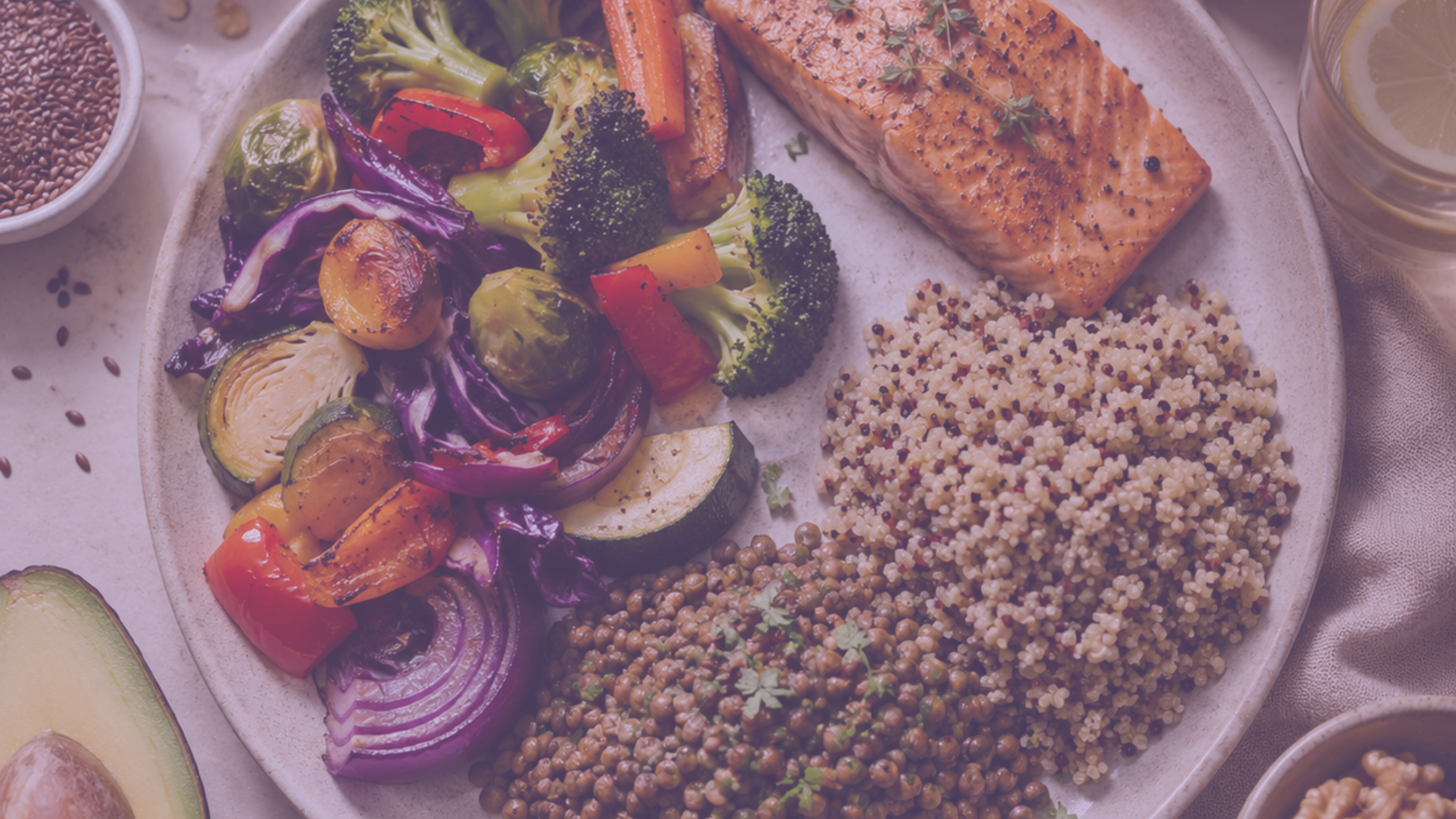
Imagine your plate divided intentionally:
Half of your plate is vegetables. Not as an afterthought. Not the sad side salad. Vegetables are your fiber delivery system, and fiber is one of the most powerful tools you have for managing PCOS. Fiber slows glucose absorption. It feeds your gut microbiome, which plays a direct role in hormone regulation. It keeps you full. It is not glamorous, but it is foundational.
One quarter is protein. Protein stabilizes blood sugar, supports lean muscle mass (which improves insulin sensitivity), and keeps hunger hormones regulated. For women with PCOS who are often caught in cycles of cravings and crashes, this matters more than most people realize.
One quarter is complex carbohydrates. Your quinoa, your lentils, your beans. These are slow-burning, fiber-rich, and critically, anti-inflammatory.
And woven throughout? Anti-inflammatory fats and antioxidants. This is where the real PCOS magic happens.
Your omega-3 fatty acids found in salmon, sardines, chia seeds, flaxseeds, and hemp seeds are directly anti-inflammatory. PCOS is fundamentally an inflammatory condition. Feeding your body foods that fight inflammation at the cellular level is not a wellness trend. It is a clinical strategy. Add in avocado, walnuts, and other healthy fats, and you are building a diet that works with your hormones, not against them.
Your body is pristine. Treat it that way. Every meal is a message you send to your cells. Make sure it’s one they can work with.
What Conventional Medicine Gets Right, and Completely Misses
Now let’s talk about the doctor’s office. Because I’m not here to villainize conventional medicine. I’m here to be honest about what it can and cannot do.
When you walk in with PCOS, here’s the standard toolkit:
Birth control pills to regulate your cycle. They work in the sense that they override your hormonal system entirely and create an artificial rhythm. But they do not heal the underlying dysfunction. The moment you stop, the cycle disruption returns.
Metformin to improve insulin sensitivity. This one actually comes closest to addressing the metabolic root. Metformin reduces the liver’s glucose production and helps your cells respond to insulin more effectively. It has real utility, especially for women with significant insulin resistance.
Clomid for fertility. For women trying to conceive, this can induce ovulation. Again, it addresses a symptom, the failure to ovulate, without asking why ovulation is being suppressed in the first place.
Steroids and anti-androgens for acne and excess hair growth. These suppress the androgen excess that causes those symptoms. They do not address why androgens are elevated.
Do you see the pattern? Every single one of these interventions is aimed at a symptom. They are putting fingers in holes in the dam. And in some cases, emergencies, fertility urgency, quality of life crises, that is appropriate and necessary.
But none of them are going to the root. And the root is metabolic.
The Root That Conventional Medicine Doesn’t Treat
PCOS, in the majority of cases, is a metabolic disorder that presents as a hormonal one.
When cells become insulin resistant, the pancreas produces more and more insulin to compensate. High insulin directly stimulates the ovaries to produce excess androgens, testosterone and related hormones. Those elevated androgens disrupt ovulation, cause the ovarian cysts that give PCOS its name, drive the acne, the hair loss, the weight changes, the mood dysregulation.
The hormones are misbehaving because the metabolic environment is signaling them to.
This is why you can take birth control for years, suppress your cycle artificially, come off it at 32 wanting to have a baby, and find yourself exactly where you started, or worse, because the underlying insulin resistance has been left unaddressed all along.
Treating PCOS without addressing insulin resistance and inflammation is like mopping the floor while the faucet is still running.
What actually moves the needle metabolically: the food you eat every single day, how you move your body, how you sleep, how you manage stress (which spikes cortisol, which spikes blood sugar, which spikes insulin, see how this works?), and targeted nutritional support where appropriate.
This is not alternative medicine. This is physiology.
A Different Kind of Living
Here’s the truth that most wellness content will not say out loud: healing PCOS is not about finding the perfect diet or the perfect supplement stack. It’s about understanding your body as a system, intelligent, responsive, and extraordinarily capable of recalibration when given the right environment.
It’s about knowing that the plate you build three times a day is either working with your hormones or against them. That the anti-inflammatory fats you eat are either quieting cellular inflammation or allowing it to fester. That the refined carbs you swap for complex ones are either spiking insulin or keeping it steady.
It’s about understanding that what conventional medicine gave you, while sometimes necessary, was a ceiling, not a cure.
You deserve the full picture. Not just the prescription. Not just the diagnosis. The actual biological story of what is happening in your body and what you have the power to change.
That’s what True Living is about.
If this resonated with you and you’d like guidance, education, and support alongside other women on a similar journey, I’d love to welcome you into our community. You can join here: www.beyondweightloss.net, connect with me at drbasaria.com/contact, or follow along on Instagram.